SENTINEL — Project Record¶
Distributed Rate Limiter — Full Project Record
Application-layer rate limiting for multi-tenant APIs, built on FastAPI and Redis. This document is the complete record: the problem, three rounds of adversarial review, the architecture, and the frozen V1 specification — everything needed to understand the project without reading anything else.
Feasibility: 8.5–9 / 10 · Status: V1 spec frozen · Stack: FastAPI · Redis · Lua
Contents¶
- The Problem
- Approach
- Architecture
- Algorithms
- State & Key Design
- Failure Handling
- Security Hardening
- Integrations
- Testing & Benchmarking
- Deferred to V2
- Status & Next Steps
01 · The Problem¶
Edge and CDN rate limiting stops blunt volumetric abuse — too many requests from one IP, one connection. It doesn't know that one endpoint costs ten times more to serve than another, that one tenant is on a trial plan and another is paying for guaranteed throughput, or that a request just got rejected because a Redis node blinked, not because anyone did anything wrong.
Sentinel sits one layer up: an application-layer limiter that understands tenants, endpoints, and policies — not just IP addresses. It's a small FastAPI + Redis library, consumed by two real applications with different traffic shapes and different tolerance for downtime: PDFTalk, a document-ingestion service, and Resumint, an AI-assisted resume tool.
The interesting part was never the algorithm on a whiteboard — token buckets and sliding windows are textbook. The hard part is making either of them correct across N stateless API instances that all share one Redis as the single source of truth, while the clock, the network, and Redis itself can each fail independently, and while someone is actively looking for the seam between "the limiter said no" and "the state actually changed."
This document is about that second problem — not "how do you rate limit," but "how do you rate limit correctly, under failure, when someone is trying to break it."
02 · Approach¶
The spec didn't go from whiteboard to code. It went through three review passes, each one explicitly trying to break the previous version rather than approve it — followed by a resolution pass that turned every open flag into one decision.
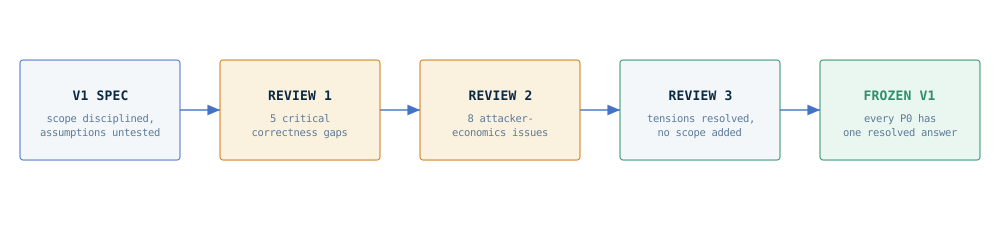 FIG. 1 — spec hardening across four review stages
V1 spec. Strong scope discipline (no Kafka, no Kubernetes, no Redis Cluster, no dynamic policy) and a sound FastAPI + Redis + Lua architecture — but it implicitly trusted application clocks, stated an approximate algorithm's behavior as exact, and left Redis-failure semantics undefined.
Review 1 — correctness pass. Found that the design's claims outran what the implementation could actually guarantee: clock skew across instances could break the token bucket, the sliding-window counter's "no boundary-burst exploit" claim wasn't strictly true, the concurrency test (allowed == limit) couldn't work for either algorithm, Redis timeout semantics were undefined, and the memory estimate was optimistic.
Review 2 — attacker-economics pass. Reframed the goal from correct under normal operation to boring under adversarial and degraded operation. Found that unvalidated Lua inputs could mint free tokens, that a shared Redis with LRU eviction could reset quotas for free, and that tenant-identity and circuit-breaker seams were exploitable.
Review 3 — resolution pass. Treated Review 2 as the new baseline and closed every remaining open question to a single decision, while explicitly refusing to let the review cycle keep adding scope: cost dropped from V1 entirely, the emergency limiter stays deliberately dumb, and the time-source testing problem got solved without forking the production script.
Result: A frozen V1 spec where every P0 item has one resolved answer — not a flagged concern.
03 · Architecture¶
One request, six stages. Each stage is independently testable — the Policy Resolver doesn't need a live Redis to test, and the Rate Limiter doesn't need a live FastAPI app.
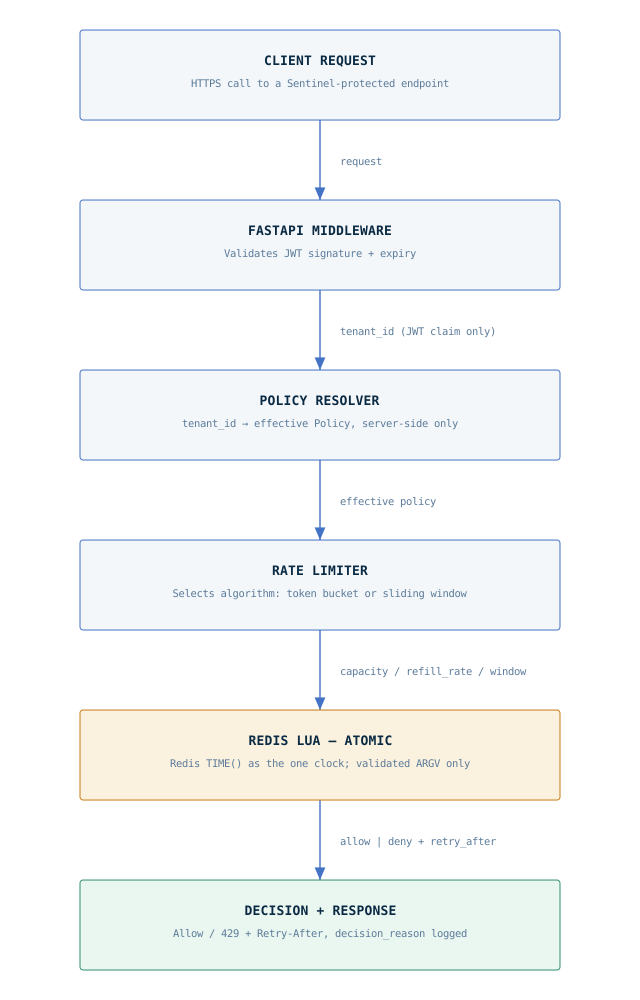 FIG. 2 — the six-stage request pipeline
The three middle stages are deliberately separate objects: PolicyResolver (tenant → policy), RateLimiter (algorithm selection and invocation), and the FastAPI middleware that wires them together. Each is unit-testable without the others — the resolver against a mock config source, the limiter against a real or fake Redis, the middleware against both as black boxes.
04 · Algorithms¶
Token bucket¶
State is stored as integer microtokens (tokens_micro, rate_micro), not floats — this removes float-drift ambiguity from the correctness tests at effectively zero implementation cost. Time comes from redis.call("TIME") inside the Lua script, always, which is what makes the bucket consistent across every API instance regardless of each instance's own clock.
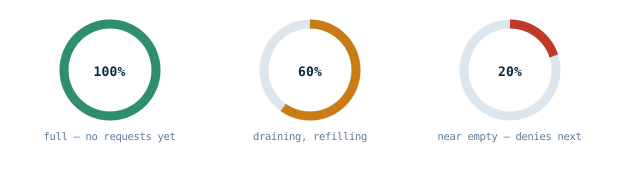 FIG. 3 — token bucket fill states
Invariant: Accepted requests can never consume more tokens than the bucket contained at the decision timestamp.
Sliding window counter¶
Instead of the vague claim "smoother than fixed window, no boundary-burst exploit," the counter is defined by one formula and tested against it directly:
Invariant: The implementation exactly matches this reference formula, verified against a Python reference model across many generated traffic patterns — not asserted as a fixed error percentage, since the real bound depends on traffic shape and was never derived analytically.
05 · State & Key Design¶
One key format, kept deliberately boring:
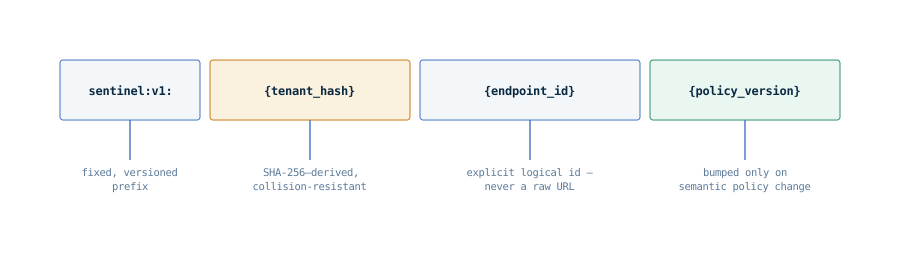 FIG. 4 —
 sentinel:v1:{tenant_hash}:{endpoint_id}:{policy_version}
No hash tags, no per-tenant hash consolidation, in V1. Both ideas are real — hash tags would future-proof a move to Redis Cluster, and consolidating a tenant's keys into one Redis hash would cut per-key overhead — but neither is worth adopting on theory. Benchmark the simple per-key format at 100K / 1M / 5M tenants first; treat consolidation as a documented follow-up if memory actually becomes a constraint, not a day-one assumption.
No cost parameter in V1. Nothing in the current scope needs per-request weighted cost, and any client-reachable numeric input is attack surface — this is exactly how the negative-cost token-minting issue happened in review. The Lua script's only inputs are the key components above plus algorithm parameters resolved server-side from Policy, never from the request itself.
06 · Failure Handling¶
Fail-open never means unlimited, and fail-closed is a documented tradeoff, not an accident.
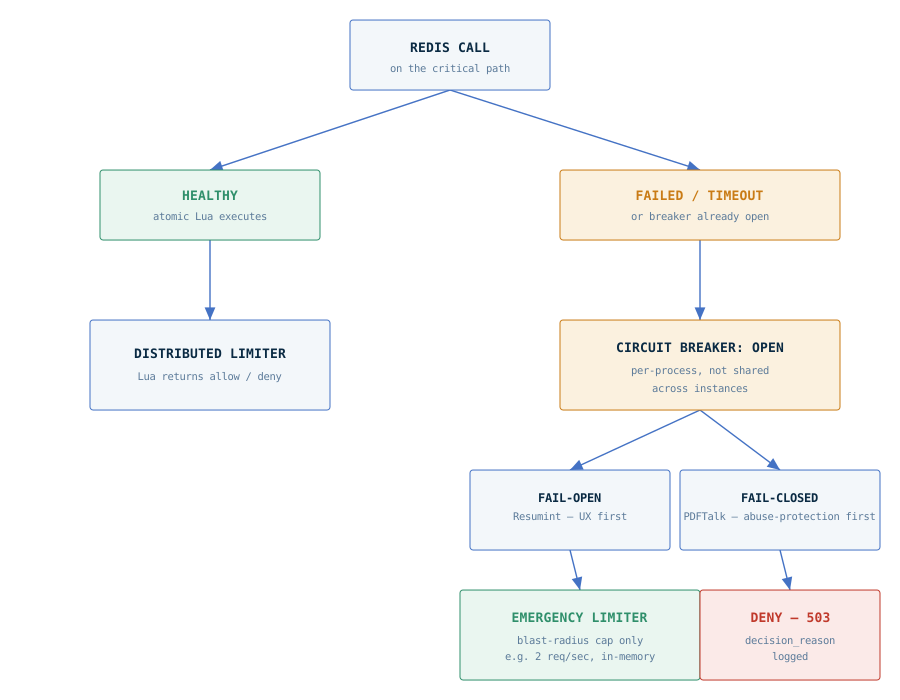 FIG. 5 — Redis failure decision tree
| Redis outcome | Fail-open (Resumint) | Fail-closed (PDFTalk) |
|---|---|---|
| Success | Use Lua result | Use Lua result |
| Timeout (20ms) | Emergency local limiter | Deny, HTTP 503 |
| Connection error | Emergency local limiter | Deny, HTTP 503 |
NOSCRIPT |
Re-EVAL once, then treat as timeout | Re-EVAL once, then treat as timeout |
| Circuit breaker OPEN | Emergency local limiter | Deny, HTTP 503 |
Every row logs a bounded decision_reason enum — the difference between an answerable incident review and log forensics.
Not idempotent. A Redis call can time out locally while the script still commits server-side. A client retry after a timeout may consume additional quota beyond what the client believes it used. Documented as a known property, not solved — solving it means idempotency keys, out of scope for V1.
Deliberate tradeoff. For PDFTalk, a Redis outage means PDFTalk is unavailable. Sentinel prioritizes abuse protection over availability for expensive compute during loss of the rate-limit store — same honesty as "Redis remains a single point of correctness," stated explicitly rather than left implied.
07 · Security Hardening¶
Everything below was found in review, not assumed away.
| Attack / risk | Found in | Resolution |
|---|---|---|
| Negative-cost token minting | Review 2 | cost removed from V1 entirely — no client-reachable numeric input |
| Eviction-as-bypass (free quota reset) | Review 2 | Dedicated Redis, noeviction, TTL-only expiry |
| Tenant identity spoofing via headers | Review 2 | Tenant id from validated JWT claim only, no header fallback anywhere |
| JWT replay | Review 2 | Named as accepted threat; mitigation lives upstream (short-lived tokens, mTLS) |
| Circuit-breaker instance targeting | Review 2 / 3 | Breaker stays per-process; damage capped by emergency limiter regardless of instance hit |
| Redis Cluster migration cost | Review 2 | Deliberately deferred to V2 — not fixed now, decided not needed yet |
| Float drift in long-lived buckets | Review 3 | Integer microtokens adopted |
| Metrics cardinality bomb | Review 2 | endpoint_id always an explicit configured id, never a raw path |
Phase 12 observability verification (SEC-08 live assertion)¶
The metrics-cardinality finding is now verified at both layers. The Phase 11 structural tripwire
proves no code path derives endpoint_id from a request object; the Phase 12 live cardinality
test fires requests at dynamic sub-paths and query strings under one guarded route and asserts
exactly one endpoint_id label value is ever emitted, and that metrics carry no tenant label
at all — only endpoint_id and decision_reason.
Accepted upstream boundaries (V1)¶
JWT replay is an accepted V1 boundary. A replayed valid bearer token is indistinguishable from
a legitimate request at the sentinel layer, so sentinel does not attempt to detect or prevent it.
Sentinel's own requirements, which the host application must satisfy when issuing tokens, stay
strict: tokens must carry both exp and sub, signatures must use a strict JWT algorithm
allowlist, and sentinel keeps no token cache and holds no token state between requests. Replay
mitigation lives upstream of sentinel: short-lived tokens, mTLS, and single-use/nonce enforcement
at the issuing service.
Redis Cluster migration remains a V2 decision (ADR-010): a single dedicated Redis instance with
noeviction is a V1 invariant, not a limitation to be worked around in V1.
08 · Integrations¶
Same library, different semantics — proof that Sentinel isn't a generic drop-in, it's policy shaped by what the endpoint actually does.
PDFTalk — Sliding window · Fail closed
Document ingestion is expensive compute. A Redis outage takes PDFTalk down rather than risk unmetered ingestion load — abuse protection outranks availability here.
Endpoint id: pdftalk.ingest
Resumint — Token bucket · Fail open
Blocking paying users over a Redis blip is bad UX, so Resumint fails open — but never unlimited. The emergency limiter caps blast radius during any outage.
Endpoint id: resumint.tailor
Both use explicit logical endpoint ids, never raw URLs — renaming POST /ingest to POST /documents/ingest must never silently create a new rate-limit bucket.
09 · Testing & Benchmarking¶
Three questions kept deliberately separate, so none of them can substitute for another.
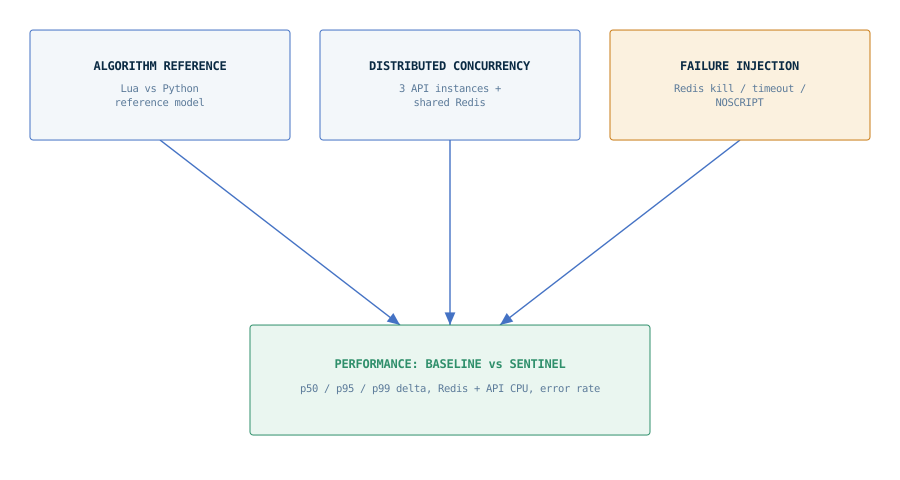 FIG. 6 — correctness and concurrency tests feed the performance benchmark, not the other way around
Four invariants, tested aggressively rather than formally proven — enough to defend in an interview, enough to trust in production:
- ✅ Token bucket: accepted requests never consume more tokens than the bucket held at decision time.
- ✅ Sliding window: implementation exactly matches the reference formula in §04.
- ✅ Identity: rate-limit identity can only originate from the validated tenant claim.
- ✅ Failure: a Redis failure never causes a request to wait beyond the configured timeout, and always resolves to a row in the §06 decision table.
Time-source testing, resolved. No dual Lua scripts, no faked Redis clock. The no-refill correctness test sets
refill_rate = 0— time becomes irrelevant to the assertion. Refill-behavior tests use short real durations with wall-clock waits. One script, tested under its real time source, always.
Phase 13 concurrency verification¶
The four §09 invariants are now also proven under concurrency (pytest -m slow):
- Exact capacity under concurrency. 50 coroutines racing one fresh token-bucket key (
refill_rate=0) admit exactlycapacityand deny the rest — in-process (gated in-flight so the hardcoded 20 ms socket budget is never exceeded on any host) and cross-process: 3 spawned processes × 20 evaluations sharing one key admit exactlycapacitytotal on healthy Redis (CI Linux). - Sliding-window bound under concurrency. A 50-coroutine burst into one window never admits more than the sequential reference simulation, and never below
limit - 1. - Breaker OPEN under load. Both fake-loader and real dead-port failure injection under concurrent load count failures across racing evaluations and end OPEN.
- Emergency cap under fail-open load. Under concurrent Redis failure the emergency limiter admits exactly one burst token (
fallback_rate_per_process_micro) and denies the rest withEMERGENCY_LOCAL_LIMIT; Redis itself never admits more than capacity even when some evaluations time out (atomicity holds at the boundary too). - Determinism note. SentinelRedis hardcodes a 20 ms socket budget; a Windows/WSL2 loopback cannot sustain ≥20 simultaneous connections within it (measured), so the strict assertions run under an in-flight semaphore (4) and the unbounded 50-coroutine stress asserts the failure-tolerant invariants above plus a strict branch when no failure reasons appear. The dead-port client surfaces as
REDIS_CONNECTION_ERRORon Linux andREDIS_TIMEOUTon Windows/WSL2 — both are accepted failure classes for that path. The emergency limiter remains documented per-process (V1).
Phase 14 benchmark verification¶
A dependency-free harness (benchmarks/benchmark.py) records the
baseline (docs/benchmark-results.md): with-Sentinel overhead ≈ 5.2× throughput at c=1 (p50
150 → 827 µs, one loopback Redis round trip dominating), breaker short-circuit ≈ 7 µs p50
(~96k ops/s), and failure-path latency ≈ the ~31 ms dead-port socket timeout (p99 ≈ 27 ms) —
the limiter itself is not the failure-path cost. Numbers are single-machine loopback, disclosed
as-is; no thresholds asserted. (Fresh three-run re-execution on 2026-08-18, post-v1.0.1,
confirmed the same story — no regression, failure-path p99 ≈ 27–33 ms, post-fix B8 counts
intact; current numbers in docs/benchmark-results.md.)
The benchmark surfaced one production defect, deliberately not fixed in the benchmark-only
phase: the fail-open emergency limiter double-refills on denied calls (emergency.py persists
tokens_after while last_refill_micro only advances on ALLOW — the Lua's "denied requests
never write" contract is violated), admitting up to ~2.3× the configured
fallback_rate_per_process_micro under sustained Redis failure (decisive experiment: Lua allows
at 0.0/1.10/2.19 s, emergency at 0.0/0.44/0.87/1.32/1.76/2.19/2.63 s at 1 token/s).
Fixed post-Phase-14 (PR #16, fix/emergency-limiter-double-refill): TokenBucketEmergencyLimiter
now persists bucket state only on ALLOW — a denied call leaves the state untouched and the next
evaluation recomputes the refill over the full elapsed window since the last write, so each
elapsed interval contributes exactly once and denied traffic cannot accelerate replenishment.
Regression coverage: deterministic sustained-traffic tests (1/2/5 tokens/s at 100 ms cadence:
allows == capacity + elapsed × rate exactly), a denied-calls-no-acceleration test, a full-journey
fail-open test through RateLimiter, and the parity test now applies no-write-on-deny to the
reference state. Verified end-to-end on the dead-port benchmark journey (1 token/s, 100 ms
cadence, 5 s: exactly 6 allows at ≈1.1 s spacing) and by a full benchmark re-run (all 18 cells
within noise of the baseline; B8/B9 failure-path p99 ≈ 26 ms unchanged).
10 · Deferred to V2¶
- Weighted request cost — its own validation, designed from scratch rather than bolted onto V1's signature.
- Redis Cluster support and the hash-tag key prefix that would come with it.
- Per-tenant Redis hash consolidation — only if V1 benchmarking shows the simple key format is actually a memory problem at target scale.
- Distributed circuit breaker state — only if per-process inconsistency proves worse in practice than the emergency limiter already handles.
- Additional algorithms, Node SDK, admin dashboard, dynamic runtime configuration — unchanged from the original scope discipline.
11 · Status & Next Steps¶
Feasible, and no longer theoretically feasible — every P0 issue found across three reviews has one resolved answer in this document.
| Phase | Estimate |
|---|---|
| Core implementation | 1–2 weeks |
| Testing & benchmarking | 3–7 days |
| Integration & documentation | 2–4 days |
Status. Implementation phases 0–19 complete. Phase 11 (PR #12) locked in every §07 finding with a
security-marked regression test or an explicit documented boundary; Phase 12 shipped structured identity-aware deny logging (identity_mode,identity_hash, reason, latency, breaker state) and boundedendpoint_id/decision_reasonPrometheus metrics, plus the live SEC-08 cardinality assertion; Phase 13 proved the §09 invariants under concurrency and real failure injection (slowsuite, dedicated CI job); Phase 14 delivered the benchmark harness and baseline (docs/benchmark-results.md) and surfaced one fail-open defect (emergency-limiter double-refill, ~2.3× fallback rate under sustained failure). That defect is now fixed (PR #16) — the emergency limiter mirrors the Lua's no-write-on-deny, sustained fallback allowance matches the configured rate, and the post-fix benchmark re-run shows no regression. Phase 15 (documentation) shipped the library entry point (README.md), the architecture walkthrough (docs/architecture.md), the failure-handling deep dive (docs/failure-handling.md), and the authoritative known-limitations list (docs/known-limitations.md); zero production-code changes. Phase 16 (packaging & distribution, PR #17) added the build metadata, wheel test suite (fresh-venv install smoke, version tripwire), thepackagingCI job, and thepublishjob (PyPI upload onv*tags, guarded by thePYPI_TOKENsecret). Phase 17's in-repo example apps were superseded by decision: integration was proven in the real PDFTalk application instead — all 8 scenarios (normal 429s, fail-closed 503, recovery, multi-process, multi-tenant isolation, auth, Lua script reload after Redis restart, observability) passed against the vendoredsentinel-0.1.0wheel; no genuine Sentinel defects surfaced (two pre-existing PDFTalk-side issues recorded there: 500 on non-UUIDsub, structlog droppingextrafields). Phase 19 (v1.2.0) added anonymous endpoint protection with signed cookie and trusted-client IP dual buckets, strict anonymous configuration, identity-aware observability, and regression coverage for cookie signing, forwarding-header rejection, AND semantics, and failure paths. Phase 18 (production readiness review & v1.0.0, PR #18) ran the full gate suite green on real Redis (374 tests, 100% coverage, mypy/ruff/pre-commit, benchmark smoke), walked the known-limitations list with no blocking findings, bumped the version to 1.0.0, and taggedv1.0.0. Historical post-release record (PRs #19–#20): thev1.0.0PyPI publish never landed (tag-time run failed on a missingPYPI_TOKEN; by the time the secret existed, the namesentinelwas already taken on PyPI by an unrelated package). The distribution was renamed tosentinel-rate-limiter(import namesentinelunchanged) and the live release shipped assentinel-rate-limiter1.0.1— verified on PyPI with correct metadata, wheel + sdist, fresh-venv installable. The wheel contents were verified clean against the packaging decision (onlysentinel/*.py+py.typed+lua/*.lua+ dist-info; no tests/benchmarks/examples/docs leaks). That historical release line is superseded by v1.2.0, which is the current version inpyproject.tomlandsentinel.__version__.v1.2.0 status. Phase 19 is implemented and documented: anonymous endpoints use a signed client cookie plus trusted-client IP dual buckets, strict anonymous-cookie configuration, and AND semantics. The current repository contains 375 collected tests; the remaining deferred V2 boundaries are listed in
docs/known-limitations.md.
SENTINEL — PROJECT RECORD · V1 SPEC FROZEN